Free to read


One of the central issues during the democratic transition in Hungary in 1989-1990 concerned the accountability of the ruling Hungarian Socialist Workers’ Party’s (MSZMP) assets and leaders. Many anticipated that a historical reckoning would ensue, that the state party’s assets would be thoroughly assessed and valued, their status in the land registry audited and scrutinized, and this immense wealth redirected and reallocated for public benefit. Such broad expectations underpinned the overwhelming public support for the relevant proposition—“Should the MSZMP account for properties owned or managed by it?”—during the 1989 “four-question referendum.” Unfortunately, events turned out otherwise. Capitalizing on their offices and connections, the state party leadership employed clever tactics not only to transfer legal title of around 2,700 properties but also to sell them off within a few years. To this day, the exact details of these transactions and the mechanism behind them remain unknown, and a precise inventory of the relevant properties has never been compiled.
To understand how this unexpected turn of events transpired, we must look back to the 1977, when the Council of Ministers of the Hungarian communist government issued Resolution No. 3339/1977 concerning the then-state party’s assets, with Paragraph 1 of the Resolution defining the legal status of the properties owned by the state party and its organs.
“Those real properties owned by the MSZMP at the time of the promulgation of this resolution or acquired hereafter by the MSZMP shall be registered as the property of the Hungarian State, with the right of management vested in the Central Committee of the MSZMP.”
Under the terms of Instruction No. 16/B/1977 implementing the Council of Ministers’ Resolution and issued by the Ministry of Agriculture and Food—which had jurisdiction over the Unified Land Registration System—changes in title and administration rights had to be duly recorded in the relevant property sheet or land registry folio.
“1. Effective September 1, 1977, the ownership rights of the Hungarian State and the corresponding management rights vested in the Central Committee of the Hungarian Socialist Workers’ Party (located at 19 Széchenyi rakpart, Budapest, District V) over properties owned by the party organization shall be entered ex officio in the land registry.
“2. Effective September 1, 1977, in the case of any real property registered as the property of the Hungarian State which is de facto managed by a party organ, but where the right of management is not registered in accordance with Paragraph 1, the management rights of the Central Committee of the Hungarian Socialist Workers’ Party shall likewise be entered ex officio in the land registry.”
In contrast, when Miklós Németh, who led Hungary’s last communist government, came to power in 1988, the Hungarian Council of Ministers issued Resolution No. 3316/1988, which decreed that the real properties subject to the 1977 government resolution be transferred into the ownership of the Hungarian Socialist Workers’ Party. The character of this legal instrument was such that the assets governed by the decree were simply reassigned from the “ownership” of the state to the state party.
A legitimate political party could not in reality have been granted a massive portfolio of real property by the state in the form of a gratuitous transfer via ministerial decree. Under the laws of the time, such a measure was considered entirely formal, given that the institutions registered as owners were never actually vested with the right of disposal over the real property in question. They lacked the authority, for example, to divest themselves of the assets with which they had been entrusted. Consequently, the Central Committee of the Hungarian Socialist Workers’ Party de facto remained nothing more than the custodian of the assets with which it had been endowed.
Party assets
Barely a year after Resolution No. 3316/1988 was issued, the state party’s assets came to the fore against the backdrop of the democratic transition. During the National Round Table Talks paving the way for the peaceful transition of power, the MSZMP maintained the position that it was only accountable to its members regarding the party’s assets. On September 26, 1989, however, pursuant to a motion tabled by opposition MP Zoltán Király, the Parliament resolved to add to its agenda a briefing submitted by the Minister of Finance on state-owned property used by and entrusted to the MSZMP, other social organizations, and the Workers’ Militia.
At 9 pm on Friday, October 20, 1989, the Minister of Finance, László Békesi, submitted the so-called “Békesi Report” to a Parliament unaccustomed to such a protracted sitting. During his remarks, he characterized the document as “a briefing rather than an itemized, precise accounting.” The Minister of Finance attributed the lack of a precise accounting to the fact that the property records did not reflect “actual fair market values but rather the so-called book values recorded at various points in time.” Békesi informed the Parliament further: “The Party Central Committee accounted for its assets and operations at the [14th] Party Congress in a format similar in both structure and content to the current briefing. The Congress took the position that the [renamed] Hungarian Socialist Party should divest itself of all property management rights—save for those properties essential for its operations—and surrender them to the government. [...] Based on a resolution passed by the Council of Ministers in 1977, all real property held by the party has been owned by the state since September 1, 1977. The government merely granted management rights to the MSZMP over the relevant real properties; thus, no settlement regarding ownership is required. […] The government shall appoint a government commissioner to oversee the transfer of the party properties.”
At the aforementioned 14th Congress of the Hungarian Socialist Workers’ Party, held on October 7, 1989, delegates resolved to disband the state party and establish the Hungarian Socialist Party (MSZP) in its place. However, a resolution alone was insufficient to bring the new party into existence, since under Section 3 (4) of Act II of 1989 on the Right of Association, then in force: “The establishment of a social organization shall require at least ten founding members to declare the formation of the organization, adopt its articles of association, and elect its executive and representative bodies.”
Since the establishment of a party was restricted solely to natural persons, this step was deferred until November 16, 1989, when 28 individuals filed for registration, which the court subsequently granted on November 21. Thus, the Hungarian Socialist Party came into being, and as a newly created entity, it could not legally “inherit” the assets of the former state party.
The “four yeses” referendum
On November 26, 1989, Hungary’s first-ever national referendum was held, presenting voters with a ballot featuring four questions along with explanatory text:
1. “Should the President of the Republic be elected only after elections to the Parliament? (By voting Yes, you support the election of the President of the Republic by the new Parliament rather than by popular vote. By voting No, you support the direct election of the first President of the Republic by the electorate.)
2. “Should organizations affiliated with the [Hungarian Socialist Workers’] party be banned from workplaces?” (On this issue, the Parliament has resolved through the adoption of the Act on Political Parties that parties shall not operate in workplaces. By voting Yes, you confirm the decision of the Parliament; by voting No, you support the activities of political parties in workplaces.)
3. “Should the MSZMP account for properties owned or managed by it?” (In its October session, the Parliament accepted a report on the assets of social organizations and the MSZMP. By voting Yes, you confirm financial accountability; by voting No, you reject financial accountability.)
4. “Should the Workers’ Militia be disbanded?” (In October, the Parliament disbanded the Workers’ Militia without a legal successor and implementation of said law has begun. By voting Yes, you confirm the Parliament’s decision; by voting No, you support the restoration of the Workers’ Militia.)
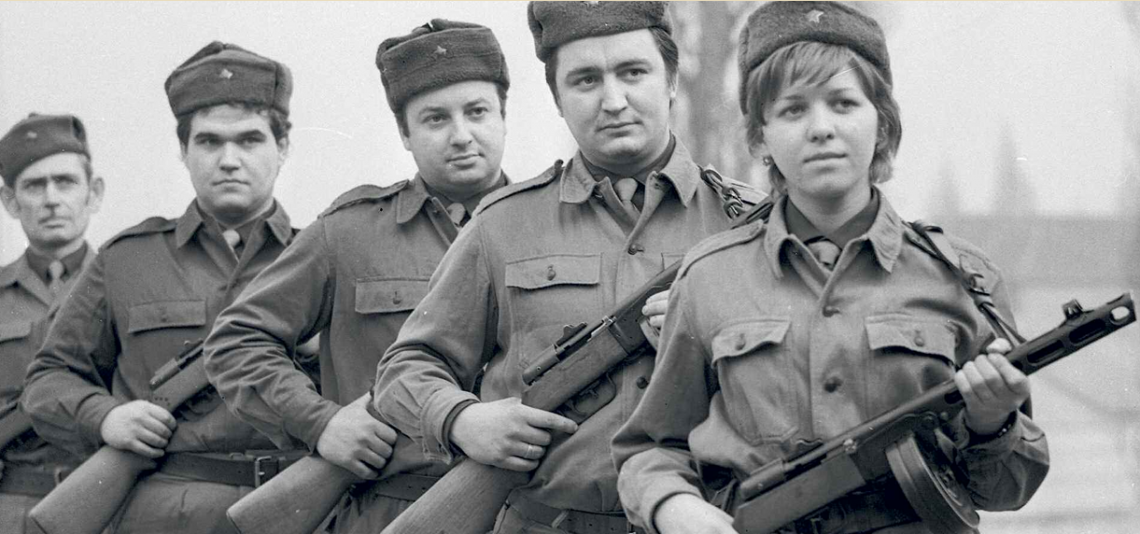
Public posters and various newspaper articles advertised the referendum questions but without the accompanying parenthetical explanations. Hardly any attention was paid to the fact that an affirmative vote on the third question related solely to the report presented by Finance Minister László Békesi. The 4,101,413 citizens who voted in favor did so in the expectation that the 2,641 real properties and other assets managed by the state party would be subject to financial accountability.
The failure of accountability
In any event, the first freely elected Parliament sought to enforce accountability. Notably, during its session of September 10, 1990, it passed Act LXXIII on the Financial Accountability of Certain Social Organizations Linked to the Past Regime, authorizing the State Audit Office to investigate what happened to the former state party’s real property holdings. However, they proceeded from the fiction that the MSZP was the successor organization to the state party, the MSZMP, given that the new party had somehow been recorded as the registered property owner in the land registry. (To this day, it remains unclear exactly how this came about.)
According to Report Number V–150–61/1991/1992, submitted to the Parliament in April 1992, information supplied by the MSZP confirmed that “the former MSZMP held title to 2,641 properties as of December 31, 1988. Consequent to changes in the asset portfolio, the number of real estate holdings had declined to 365 by August 31, 1990.” At the same time, the state auditors failed to receive the necessary documentation from the MSZP regarding the fate of the over 2,000 missing properties. As the party’s treasurer, László Máté issued a formal declaration to the State Audit Office that the missing records could not be recovered.
“Regarding the asset accounting of the MSZMP, I, the undersigned László Máté, acting in my capacity as the treasurer of the MSZP, do solemnly declare under penalty of perjury that the missing information requested by the State Audit Office for verification under Act LXXIII of 1990, as amended by Act LI of 1991, cannot be provided given that we are no longer in possession thereof and the said documentation cannot be retrieved by our organization.”
Notwithstanding the State Audit Office having notified the government and the Parliament, in the course of the audit and supplemental audit, and subsequently in its reports and formal warning advisory letters, that the accounting of the MSZP’s assets could not be considered complete and verifiable, the assembly nevertheless voted to accept the party’s asset settlement. Provision for this was made under Section 1 and the related annex of Act IV of 1993 on Measures Related to the Accounting of Assets of Certain Social Organizations Tied to the Past Regime, which took effect on February 4, 1993.
To date, no inventory or statistical record has even been produced detailing the assets that underwent so-called “spontaneous privatization,” which state-owned properties were sold off, and what the true value of these assets was. This remains one of a series of events that remains unclear to this day, casting a persistent shadow over the democratic transition of 1989-1990.
(translated by John Puckett and Andrea Thürmer)