Free to read


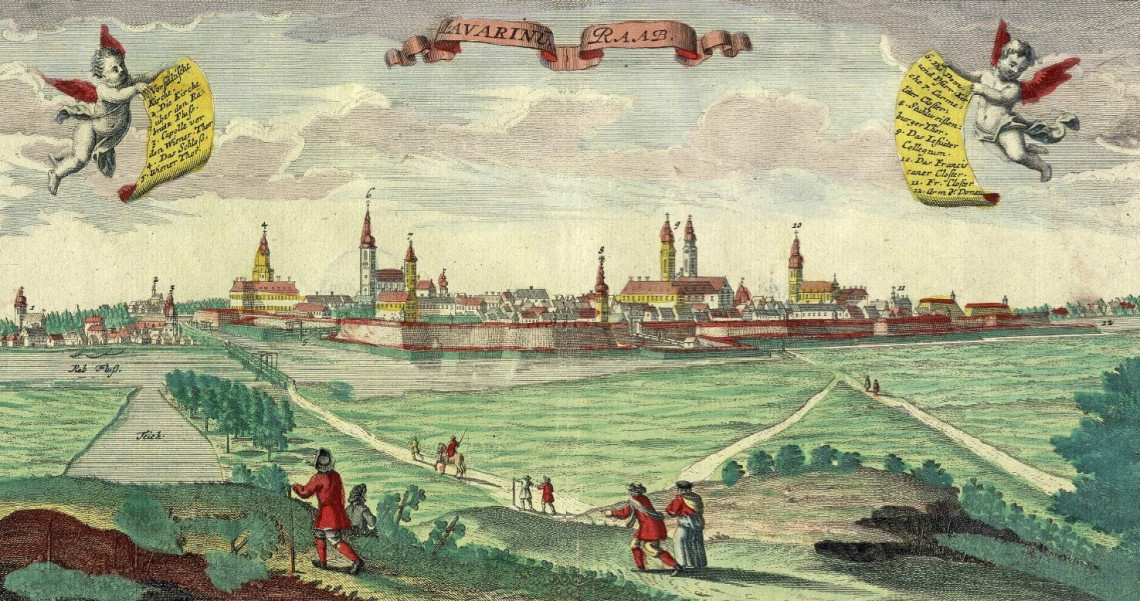
After 1526, the Ottoman Empire renewed its attempts to expand into Hungary, and within a few years the threat of devastating plundering campaigns had become a grim reality for western Transdanubia and the Austrian provinces. In the wake of the Sultan’s campaign against Vienna in 1529, scores of medieval villages between Buda and Székesfehérvár and the western frontier were burned to the ground, their inhabitants either enslaved or forced to flee. The continuing Ottoman raids of the following years, together with the internal conflicts of the civil war, made the fortification of the region’s fortresses and the defense of its towns increasingly imperative. In the 1540s the situation became particularly grave following the fall of Buda, Esztergom and Székesfehérvár, bringing the Turks into ever-closer proximity. Stretching along the Buda-Vienna route, Győr’s fortress emerged as a decisive fortification along the new defensive line in western Transdanubia. Not only could the fortress’s garrison maintain control over the crossing point on the Rába and Danube rivers, but it also maintained communication with the fortresses to the east and south, in the Vértes Mountains, on the left bank of the Danube and in the Balaton Uplands.
Győr possessed a distinctive medieval character and had been regarded as a “civitas” (a market town with special or autonomous privileges) for decades. The Bishop’s Palace stood on the walled hill (Káptalan Hill) situated at the confluence of the Danube and the Rába rivers. Surrounded by walls dating back to Roman times, it boasted an episcopal inner town extending around it. Beyond the town proper lay a number of village-like suburbs, whose ownership was shared by the cathedral chapter, the bishop, and the Héderváry family. The fortress, however, was situated on a small parcel of land making it unsuitable for accommodating a large military force. Although the two rivers provided defense, the outer moats and rampart could not keep its enemies at bay and thus, by the 16th century, it could not be considered a significant stronghold. The site, nonetheless, was important as both a major ecclesiastial and administrative center and a hub for the exchange of agricultural products and manufactured Western goods.
The Emergence of a Fortress
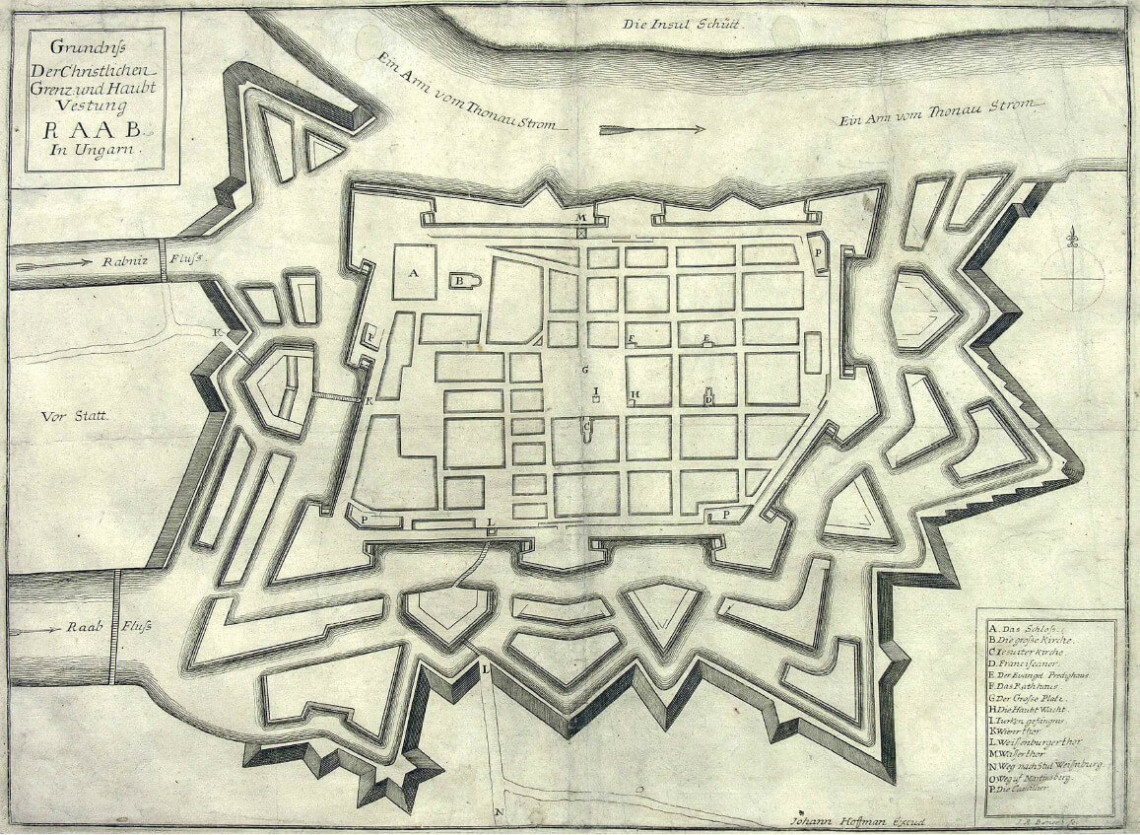
As the Ottoman attacks intensified, it became increasingly clear that a prompt decision was needed: whether to continue fortifying the old fortress or, alternatively, to enclose the entire fortress district with walls and bastions in place of the existing ramparts and palisades. Finally, in the 1560s, the decision to proceed with the project was made in Vienna. Construction began on a modern fortification system surrounding the entire fortress district sealing the fate of medieval Győr. The simple settlements surrounding the town—whose churches were soon demolished—quickly disappeared. A portion of the population moved to Újváros, a suburb protected by the Rába and Rábca rivers.
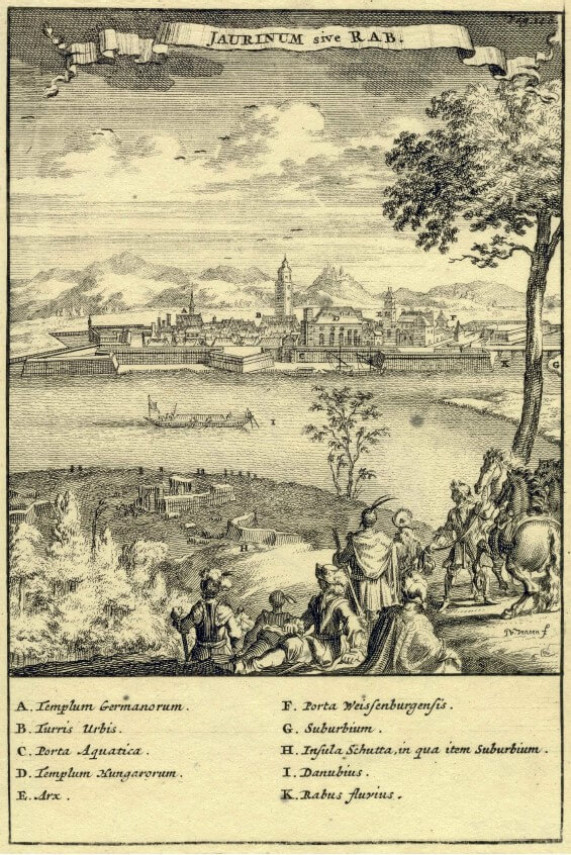
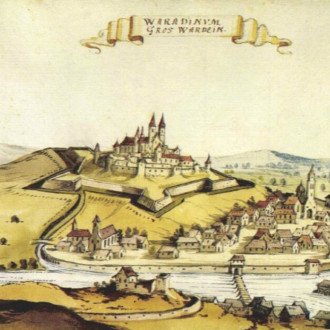
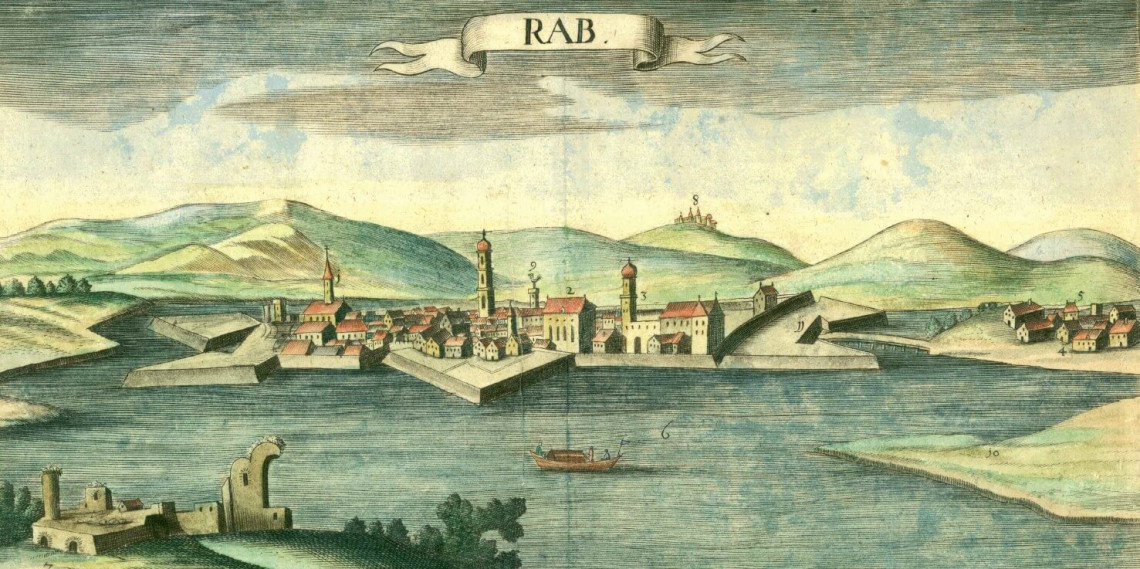
Jaurinum or Rab (the Latin and German names for Győr). A schematic view from the final decades of the 16th century showing the northern bank of the Moson Danube as seen from the Csallóköz region, featuring the town gates, the “Hungarian” and “German” churches, with the fortress of Szentmárton (Pannonhalma) in the background
The fortress, which encompassed the town itself and whose construction and expansion continued for decades, was completed by 1574. Needless to say, the number of troops stationed there had already been significantly increased while construction was still underway. Between 1556 and 1682, the strength of the Hungarian garrison in Győr averaged between 700 and 750 men, depending on the military situation. To this we can add another two or three German infantry battalions, numbering 600 to 900 men. This strength enabled the Győr garrison to go beyond defending the fortress and engage in disrupting Turkish regiments both near and far. For many years, the garrison was comprised of light cavalry with their primary role being not to defend the walls, but to keep the enemy at bay.
Power Relations
Changes in the town’s urban structure largely shaped local power dynamics. From the 1550s onward, the captains-general took up residence in the bishop’s palace, while the bishops—if they happened to be present in the town at all—found lodging in the mansions of their court stewards. The cathedral chapter exercised their seigneurial rights, while the Héderváry family’s landholdings dwindled as the outlying districts fell into ruin. The chapter essentially became the town's sole feudal lord, but its power was significantly diminished by the presence of the border garrison and, above all, the captains general.
Supreme authority within the fortress rested with the chief captain regarded as the “image of the king”, and his deputy. They subordinated all other interests to the fortress’s security. For example, in 1577, Captain General Andreas Teuffel, together with the town judge and a juror, sent word to the provost that if his orders were defied, the provost would be expelled from the town. In 1626, the Captain General told the town judge, who was invoking the authority of the cathedral chapter: “By the time your magistrates hear of this, they might well hang or find themselves impaled on a spit.”
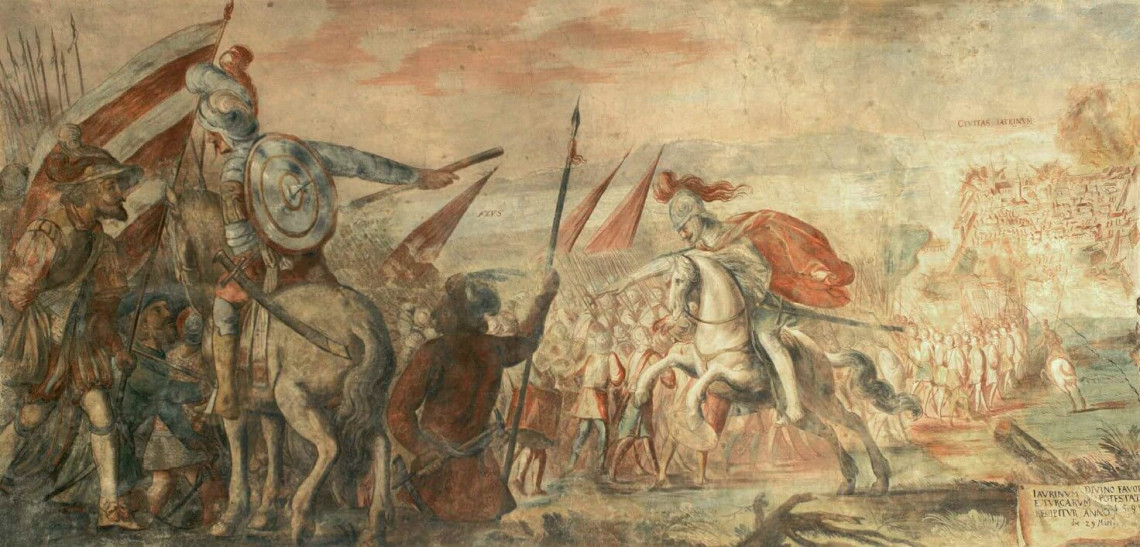
Fresco from Nádasdy Fortress in Sárvár depicting the recapture of Győr on 29 March 1598. The lower right-hand scene commemorates the participation of the Nádasdy hussars and the explosion of the so-called Church Bastion.
Tensions were further exacerbated by the fact that for two centuries after Mohács—with only a minor initial interruption— only Austrian nobles and magnates held the office of captain general. Their deputies, meanwhile, were drawn from the ranks of the Hungarian nobility. As the town was of paramount importance to Austria’s defense, Austrian and German imperial troops made up a significant portion of the garrison.
The town’s social fabric underwent major changes with the constant presence of foreign troops. In addition to mercenaries, foreign artisans for whom it was their primary role to fulfill specific military needs (weaponry manufacturing and repair, clothing supplies, etc.), also settled in Győr. Their close connection with the military and, indeed, their placement under the authority of the military, set these foreign artisans apart from the local artisans. The guild privileges of the German cobblers, for instance, were granted directly by Captain-General Andreas Teuffel (1582). This meant that the regimental judge became the court of appeal for the guild’s affairs. By the 17th century this practice had become so prevalent that other captains general likewise issued such charters of privilege, thus leading to a dual system of guilds: one under military authority and the other under the authority of the landowners. This dual system of guilds became permanently established in the town.
The Coexistence of Soldiers and Civilians
The large permanent military presence had a considerable impact on local housing conditions and the food supply. As early as the 1530s, townspeople, already devastated by the effects of war and subjected to a constant military presence, were driven from their homes and forced to live in huts and wooden shacks. This situation became worse in the 1560s. According to the register of plots and houses compiled between 1600 and 1603, the proportion of original military property owners (before the Turkish siege of 1594) exceeded 50%. A typical case that exemplifies how soldiers’ seizures of property impacted common citizens would be that of János Lukács when in 1567, a cavalryman settled himself into Lukács’ home, proceeded to renovate parts of the house and then sell the home to a fellow soldier as “owner” of the property.
In order to safeguard their homes as well as ensure much needed accommodation, home owners proceeded to construct additions or quarters in their court yards which were then increasingly bought and sold as extensions of their houses. In 1637 the chapter remonstrated that citizens were being compelled to build not only one, but two sets of quarters on their properties. If that were not enough, German soldiers would then “set their beds up next to those of the owners - soldiers so terribly ill and lice-infested that quite a few fellow citizens had fallen ill.” Under these circumstances, it was not only common for disputes to arise but, in fact, bloody clashes occurred between citizens and billeted soldiers, the victims of which were almost always the civilians. Frequently, Hungarian and German soldiers would be brought before a court on murder charges.
Provisioning the soldiers was particularly problematic. Owing to procurement difficulties and frequent shortages of funds, the military provisioning office was only rarely able to supply the garrison. The fortress’s inhabitants were forced to provide for themselves, initially in part through plunder and, in the longer term, through farming and trade. Soldiers frequently plundered markets, attacked food suppliers at the town gates, and “taxed” cattle drovers for their herds. Under the cover of night, they drove the townspeople’s livestock from the town stables and butchered the animals on the bastions. They also harvested the vineyards on the hills surrounding the town of Sokoró and consumed the wine stored in the cellars. In order to raise essential military operation funds, the German military judge routinely extorted money from the town’s affluent merchants under the guise of tax collection. The practice of forced purchasing also became pervasive: in 1590, Deputy Captain-General Gregoróczy forced citizens to buy his spoiled wheat; in 1592, Captain-General Hardegg forced them to buy his mutton; and in 1649, in lieu of pay, peasants were forced to accept salt.
Meanwhile, destitute Hungarian soldiers and officers proceeded to take possession of the farmlands surrounding the town. The 1592 episcopal urbarium noted that the lands of the former Királyfölde suburb were being used by soldiers. In 1606, the garrisons of Győr, Pápa, and Veszprém wrote in a joint letter to the estates of Lower Austria: “The time for harvesting has come upon us; we must gather hay and fodder in addition to securing the means of our own sustenance.” In 1667, Cavalry Lieutenant József Miskey reported to Captain-General Montecuccoli that, following the recapture of Győr, the soldiers had begun cultivating the fallow lands surrounding the town to secure their own livelihood, which was undoubtedly a positive development, as they earned their living through honest work rather than plunder.
Győr’s position as a commercial intermediary provided an opportunity for Hungarian soldiers, who “were paid irregularly,” to join the westward bound continental European cattle trade. The cattle they purchased from drovers arriving from the Great Hungarian Plain were then driven, like those traded by the town's civilian merchants, to Magyaróvár or Vienna, where they were sold at a profit. In 1679, five Hungarian cavalry officers from Győr testified during a customs investigation that they had been trading in cattle for years, in partnership with townspeople.
Additional heavy burdens placed on the citizenry included those functions that were specific to military services: the procuring of wood for the signal fires at the 17 military guard posts on the fortress walls; the provision of special gratuitous horse-drawn carriages for couriers or for hauling canons; and, the transportation of infantry. On such occasions, coachmen, themselves, would take part in the skirmishes as is evidenced by the August 1577 battle between Győr and Szentmárton where 33 civilians died.
Special Legal Relationships
Despite Győr’s recognition as a market town enjoying privileged status, neither the privileges nor the parliamentary committees sent to investigate complaints of military abuses could offer any protection to the citizens of the civitas. The only way citizens could avoid the extraordinary burdens and taxes forced upon them was to find individual solutions and take matters into their own hands. Among these was to sign onto the military payroll, that is, enlist in the military, but only nominally. The complications this solution created were recorded in a memorandum from the cathedral chapter in 1558 that emphasized that the fortress command were unable to rely on soldiers who continued to partake in their civilian occupations during raids and sieges. Regardless, even as late as January 1609, 52 people had withdrawn themselves from the town jurisdiction along these lines.
The coexistence of soldiers and townsmen shaped not only the town’s social and economic life but also its legal relations. The complexity of these relations was further increased by the inhabitants’ differing legal status, including nobles and commoners, Hungarian and German soldiers, and county nobles residing in the town. As a result, an intricate and highly complex legal system developed. Criminal cases involving persons from the Austrian hereditary lands and the Holy Roman Empire were handled by military judges, the soltész, and the provost marshal. During the 1590s, Hungarian soldiers likewise acquired their own judicial authorities in the persons of the army judge and the army clerk. Whenever a legal dispute involved both a Hungarian soldier and a civilian, it was heard before a so-called “mixed court,” whose members included military officers, municipal and county officials, and, where appropriate, even the judges of the Serbian soldiers settled in Újváros.
Naturally, this did not prevent captains general and their deputies from setting aside standard practice and exercising their authority against townsmen and nobles alike while protecting soldiers from the administration of justice. In 1627, Voivode Péter Kláris mortally wounded a townsman. Because Kláris was a nobleman, the cathedral chapter, acting as the victim’s feudal lord, brought charges against him before the county court. Deputy Captain-General Pál Zichy, however, threatened to arrest the vice-lord-lieutenant and the county officials responsible for carrying out the sentence. On another occassion, in 1637, a merchant nobleman named Miklós Iványos was dragged from his townhouse and flogged with 27 lashes in the market square for his commercial dealings with the Ottoman-occupied territories.
The jurisdiction of the military authorities, needless to say, also extended beyond adjudication. Military judges likewise handled the “civil” affairs of German soldiers issuing documents, handling real estate transactions, as well as drawing up wills.
Most members of the Hungarian nobility conducted their legal affairs before the cathedral chapter in its capacity as a place of authentication and thereby—if only formally—undertook to bear the seigneurial obligations attached to the ownership of plots and houses. Thus, at least in principle, they acknowledged the chapter’s property rights within the town and their inviolability, although they naturally paid no taxes and made no contribution to civic burdens.
The close coexistence of the large Hungarian and German military communities along with that of the civilian population resulted in the emergence of Győr’s distinctive socio-economic character. Among the town and frontier fortresses of Hungary, Győr can truly be called a fortified town. These conditions remained unchanged for decades until Győr’s status as a frontier fortress ended with the expulsion of the Turks, when Győr could finally embark upon more civic-oriented urban development, freed from the burdens imposed by the military presence.
(translated by Andrea Thürmer)