Free to read


The 1699 Treaty of Karlowitz was an extremely complex peace treaty whose negotiations involved all the leading European powers of the day. The peace marked a temporary end to the centuries-long struggle between the Ottoman Empire—already past the height of its power and increasingly integrated into the European balance of power—and the Holy League. This alliance brought together the Habsburg Monarchy, which had grown significantly stronger in the late seventeenth century, Russia, likewise ascending under Peter I, as well as Poland and the Republic of Venice.
The Ottomans—once feared throughout Europe and long considered invincible—had seen their power weaken and were now constrained to make ever greater compromises. As a result, they were forced to accept conditions dictated by one group of Christian powers, as mediated by another group—England and the Dutch Republic—which had significant commercial interests at stake and were intent on maintaining the political balance of power in Europe.
England, the Dutch Republic, and France—in pursuit of their own interests—sought to prevent Vienna and her allies from enjoying the full fruits of their victory over the Ottomans in what became known as the Great Turkish War (1683–1699). Consequently, the Turks, thanks to the wise counsel and skillful diplomatic efforts of the English and Dutch envoys, managed to conclude a peace treaty on much more favorable terms than would have been the case had they been forced to conduct negotiations on their own.
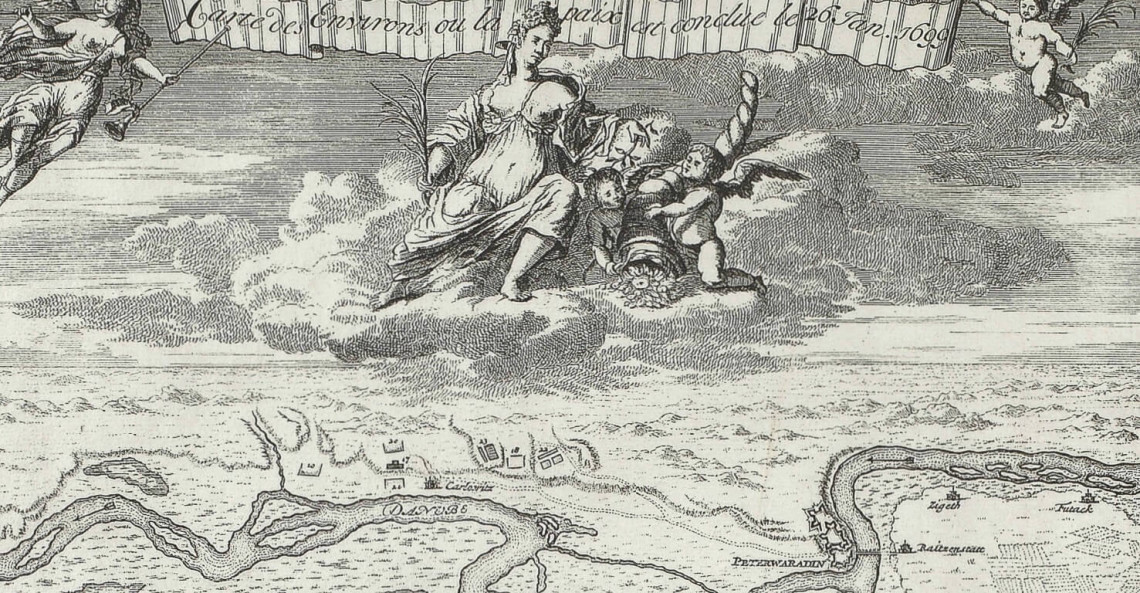
The subsequent Treaty of Karlowitz, following lengthy negotiations brokered by England and the Dutch, was signed by the Ottoman Porte and the Holy League on January 26, 1699. The Russian Empire, engaged in a separate conflict with the Turks, agreed to a truce at Karlowitz before concluding its own peace treaty with the Porte in Constantinople on July 14, 1700. Peace negotiations between the warring parties began shortly after Buda had fallen into Habsburg hands in 1686 but were conducted with the utmost secrecy so that the Habsburgs’ main European rival, King Louis XIV of France, would be kept in the dark. Louis, the “most Christian king,” endeavored to use the Ottomans as allies in the struggle for European hegemony and possession of the Spanish throne. To this end, French diplomats encouraged the Turks to continue the war while French military advisors provided concrete military assistance.
The pathway to peace
The first exchange of diplomatic letters between the Ottoman and Viennese courts began as early as the end of 1686, after the fall of Buda, and was followed by the arrival of Ottoman envoys in the Habsburg capital for discussions. In 1688, a secret conference was held among Emperor Leopold I’s most senior advisors, who decided that a peace treaty with the Ottoman Porte would have to be negotiated. The reason was that it had become clear to all that war was in the offing between Leopold and Louis XIV of France, as rival claimants for the soon-to-be vacant throne of the childless Spanish king, Charles II. It was thus essential that the emperor be able to deploy his entire army against the French king and avoid a two-front war.
The secret negotiations, however, came to a standstill despite the best efforts on the part of the Dutch and English, who were interested in maintaining trade with the Ottomans while defeating their chief enemy, Louis XIV, as quickly as possible. Excessive demands on the part of the Ottomans were one reason for this. The other was the growing imperial court influence of Chancellor Kinsky and General Antonio Caraffa, who wished to establish a power base in Southeast Europe. The latter especially believed that the pathway to the castles of Spain led through the fortresses of Hungary. To add to the problems, the Grand Vizier Fazıl Mustafa Pasha still held out hope of regaining the initiative in order to bolster his position.
Notwithstanding the grand vizier’s ambitions, the Ottomans did not completely abandon their diplomatic “campaign.” Consequently, Vienna seemed willing to relinquish Bosnia and Wallachia, which had belonged to the Hungarian crown since the Middle Ages. Accordingly, in late 1691, Vienna officially agreed to have the English and Dutch, allies of the Habsburgs, enter into discussions with the Porte as official diplomatic relations between the warring parties had been severed at the outbreak of the war. Over the next several years, the English ambassador in Constantinople, Lord Paget, endeavored to make the Ottomans understand – and above all, accept – the principle of uti possidetis (“as you possess”) as a basis for negotiations. However, it was not until the decisive victory at Zenta, in late 1697, that secret informants of the Viennese court were able to report serious headway on the path to peace.
Parties to the peace treaty:
The Ottoman Turks
The turning point for the Ottoman Porte came in January 1698, when the empire’s leading personages gathered for an extraordinary council and resolved to make peace. The fact that King Louis XIV had made peace with the Habsburgs at Ryswick in 1697, ending the Nine Years’ War between France and the Grand Alliance, was certainly instrumental in the Turks’ decision. Being on the losing end of the war in Southeastern Europe, the Ottomans were forced to enter peace negotiations from a position of great weakness; moreover, the Ottoman ruler – Sultan Mustafa II – lacked a diplomatic apparatus trained for such a task.
The Ottomans’ first envoy was Rami Mehmed Pasha – the reis ül-küttab, or head of foreign affairs – whose education, knowledge, and wisdom far exceeded those of his compatriots, earning him the respect of his contemporaries. As part of the peace delegation, Rami Mehmed exercised his authority by setting forth the negotiation strategy. However, since the Pasha spoke no European languages, the main interlocutor on the Ottoman side was Alexander Mavrocordatos, the Phanariote. An Italian-educated doctor of medicine, Mavrocordatos served as chief interpreter at the Porte for over twenty-five years, and other than a brief interruption around 1683, he was a leading figure in Ottoman diplomacy. In addition to his impeccable command of Italian and Latin, polite manners, and excellent knowledge of the Christian world and court practices, the Turks also valued Mavrocordatos for his intelligence, shrewdness, and ingenuity. The grand vizier, Fazıl Mustafa Pasha, followed the course of the peace negotiations with utmost attention.
Although the Turks were on the losing side in the war, they betrayed no helplessness or weakness either at the negotiating table or in how they presented themselves, maintaining at all times a determined and resolute demeanor. Rami Mehmed Pasha scrutinized the smallest matters in intricate detail. On some points, he had to consult the text of previous peace treaties; on other occasions, he had to ask his advisors for suggestions or reports. His arguments were often persuasive to his opponents, aided in no small degree by the fact that not everyone on the Christian side was in agreement with the originally conceived peace terms.
The Christians
Emperor Leopold, on the other hand, was represented by two envoys of ministerial rank. The first was Count Wolfgang IV of Oettingen-Wallerstein, president of the Imperial (Aulic) Council – the emperor’s advisory body – who owed his appointment to his highstanding and unconditional loyalty. The negotiations, however, were led by Count Wolfgang’s younger companion, Count Leopold Schlick. An outstanding military commander well-versed in the most important military and security issues, he enjoyed close ties with the minister responsible for foreign affairs, Franz Ulrich Kinsky. Schlick also possessed a good command of Italian, which was important since most of the proceedings were conducted in this language. The Habsburg delegation was further bolstered by Count Luigi Ferdinando Marsigli; originally from Bologna, Marsigli assisted the imperial delegates mostly with geopolitical issues and behind-the-scenes tasks.
The Venetian Republic dispatched one of its most experienced diplomats: Carlo Ruzzini. A veteran diplomat at the courts of France, England, the Netherlands, Spain, Istanbul, and Vienna, Ruzzini had successfully negotiated Russia’s entry into the anti-Turkish alliance. Poland delegated its highest-ranking secular nobleman, Count Stanisław Małachowski, the voivode of Poznań, while Tsar Peter of Russia was represented by Prokofy Bogdanovich Voznitsyn, whom the tsar had promoted to the relatively obscure position of duma clerk (dumniy d’yak) in order to place him on an equivalent standing with the other imperial delegates. Voznitsyn was considered an Ottoman expert within the Russian Foreign Ministry and his primary was to obstruct peace and continue the war alongside Moscow’s allies.
Representatives of the maritime powers, England and the Netherlands, played an exceptionally important role not only in the preparations leading up to the peace process but also in the negotiations themselves. William Paget, 6th Baron Paget – who had previously represented England at the court in Vienna and at the Ottoman Porte, where he had been appointed ambassador in 1692 to prepare for the peace – served as King William III’s envoy and effectively “chaired” the conference. Paget possessed a keen insight into the affairs of both the Habsburgs and the Ottomans. The Dutch – whose interests closely meshed with the English – were represented by the engaging and quick-witted Jakob Colyer. The son of a diplomat, Colyer had grown up in Istanbul, spoke Turkish fluently, and was well-acquainted with local conditions. As is evident from the list of the key participants, Hungary was not granted separate representation; instead, as part of the Austrian Empire, its interests were represented by the Habsburg envoys.
The location
Although preliminary discussions had concluded by September, there was still no agreement regarding the location of the planned peace conference. The Austrians proposed Vienna or Debrecen, but the Turks rejected any idea of holding talks in Austrian territory, so the allies were forced to accept the border region of Syrmia, situated between the Sava and Danube rivers. The choice fell on an open field near the ruined, deserted town of Karlowitz (Karlóca). Lying on the banks of the Danube, the site was strategically located between Austrian Peterwardein (Pétervárad) and Turkish-held Belgrade. The envoys and their entourages set up camp at sites designated by Count Marsigli: the Austrians and their allies on the Peterwardein side, the Turks on the Belgrade side, and the English and Dutch mediators in between.
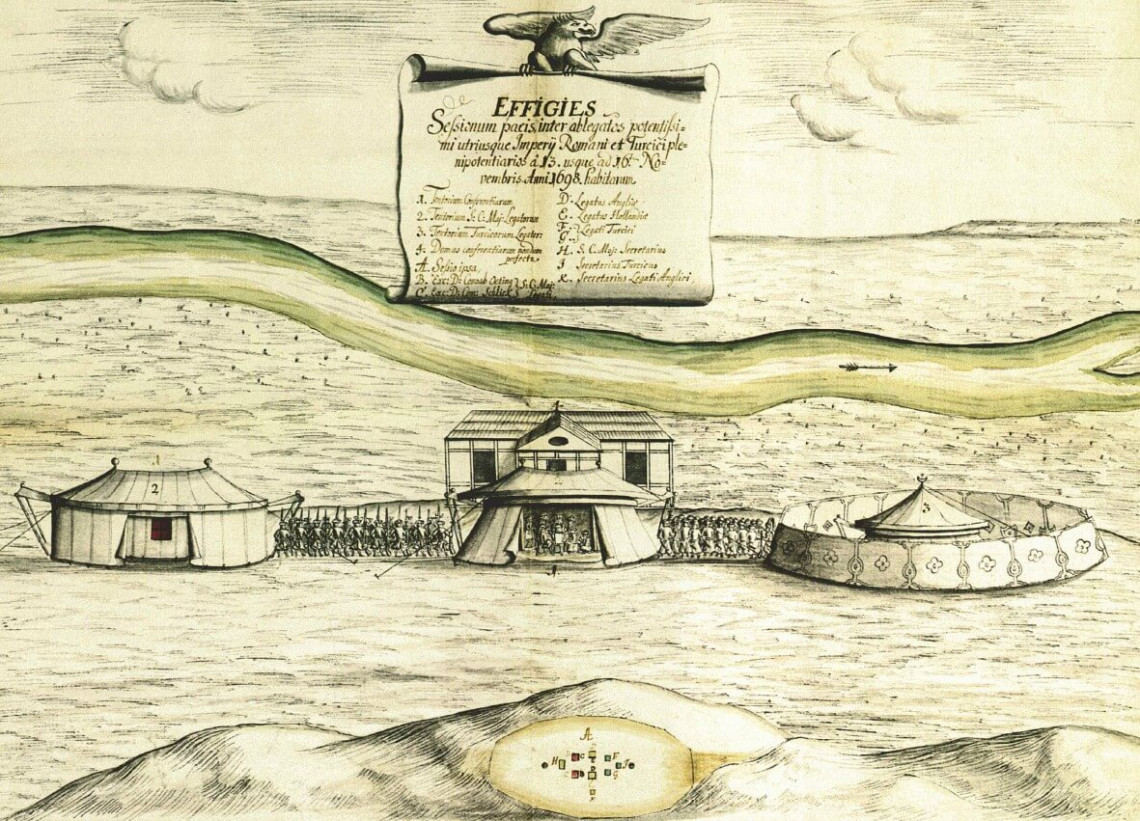
As a venue for the talks, a large wooden house divided into three wings and modeled after the Ryswick Palace in the Netherlands was erected in the mediators’ camp. The peace conference was conducted according to strict rules patterned after the peace conference held the year earlier. Each party was provided a separate entrance, thus avoiding the possibility of discrimination or favoritism; likewise, each had a separate room to which they could retire, with the central hall serving as the venue for talks.
The envoys were permitted no more than one or two carriages when traveling from their camp to the venue for the talks, thus precluding their usual large entourage. Unauthorized movement between the camps was strictly forbidden, with permission granted only in exceptional cases. The Austrian and allied camp was guarded by some 2000 imperial infantry and a cavalry regiment, with sentries posted on the tops of the surrounding hills, along the river, and in the ruined town of Karlowitz. The mediators’ camp, in turn, was defended by 180 German cavalry and infantry, as well as 300 Turkish Janissaries and 200 cavalry. Lastly, the Turkish camp – located equidistance from the mediators’ camp as were the imperial forces – was protected by some 3000 troops on foot and on horseback. These troops were required for the safety and reassurance of both sides as their respective main forces were withdrawn.
Due to haste exhibited primarily on the Austrian side, less emphasis was placed on the typical solemnities and formalities usually associated with courtly functions. However, since one of the Ottomans’ chief goals was to maintain the appearance of their great power status as much as possible, the basic formalities of courtesy and equality of rank were ultimately taken into account. For example, the negotiating parties had to enter the room at the same time, and only after the mediators had given a signal. In the “conference room” itself, everyone had their own assigned seat, located on the same side that their camp was situated.
The negotiations
Emperor Leopold, due to his armies’ military successes and the impending Spanish Succession crisis, had agreed to convene a peace conference with the Porte without the consent of his allies, forcing the members of the Holy League to enter negotiations from a position of weakness. The uti possidetis principle put forward by Vienna as a basis for negotiations had already proved quite divisive among Austria’s allies, who had to negotiate separately with the Turkish representatives and settle the postwar situation through bilateral treaties. Thus, the Christian parties who fought side by side in the war against the Turks found themselves struggling alone – and sometimes against each other – in order to defend their interests during the peace negotiations. Vienna’s goal was to conclude peace as soon as possible, curb its allies’ ambitions, and, last but not least, thwart the malicious intentions of the Turks.
By October 25, 1698, all the delegates had arrived in Karlowitz, although the actual negotiations did not begin until November 13. The talks were complicated by the fact that there was no common language spoken by the parties in which the delegates representing seven different countries could negotiate. In the end, Italian was chosen as the conference language since it was spoken by the majority of the attendees, although an interpreter was still required. Nevertheless, the language barrier not only slowed down the pace of negotiations, it also led to some misunderstandings. The text of the resulting peace treaty was ultimately drafted in Latin, while the Ottomans, naturally, had their version drafted in Turkish.
The Austrian authorities intended to define the boundaries of the newly occupied territories along various rivers, mountains, and other natural features and in accordance with the maxim uti possidetis, ita porro possideatis (“as you possess, so may you continue to possess”), which was the basic principle underscoring the peace conference. Throughout the peace negotiations, the sultan’s representatives consistently emphasized that the purpose of the conference was to discuss the evacuation of various territories, the razing of fortifications, and other requisite matters they deemed worthwhile to address. They insisted most emphatically that they did not intend to mark out the boundary line between the Austrian and Ottoman empires and preferred to entrust this task to a border survey carried out by commissioners appointed after the negotiations.
The Ottoman approach to diplomatic negotiations, which the Venetian representative Carlo Ruzzini termed “the cunning of the Turks,” required a great deal of skill, tact, and flexibility. For when it came to moving from stated principles to practical solutions, the Turks were able to use novel interpretations of technical terms when resolving specific issues, helped by the fact that they never wrote down the clear-cut meanings of these terms. Using this method allowed them to resolve difficult issues without having to abandon their core principles. Since the Austrian envoys were cognizant that the Porte would view a strict application of uti possidetis as an outright attack, they tried to enforce a quid pro quo policy on a one-to-one basis. In practical terms, this meant that for every fortress or territory surrendered or destroyed, the Turks would have to give the equivalent in return. The Ottoman negotiators, however, steadfastly insisted that no Turkish-held territory should fall into enemy hands as a result of the peace negotiations. Ultimately, the Austrian side tacitly accepted the Turkish interpretation of uti possidetis, which would entail an official Turkish evacuation of the territories in question along with the demolition of any fortresses, something that would cause Austria’s allies much trouble later on.
The most contentious topic of negotiations concerned Transylvania. Since the emperor – as king of Hungary – laid claim to the territory as an integral part of the lands of the Hungarian crown, he refused even to send an annual tribute to the Ottomans in exchange for it. Ultimately, the sultan’s representatives were forced to concede the principality but received the Temesvár district in return, although all the fortresses outside this provincial capital remained under imperial control. Ruzzini, the Venetian ambassador, noted with regret that their Austrian allies were all too ready to agree to the destruction of various fortifications and territories. Moreover, apart from certain areas and some specific stretches of river, the Austrians had also agreed that the final detailed demarcation of the borders would be carried out later by commissioners appointed for this purpose.
The Treaty of Karlowitz is significant for a number of reasons. Although, like previous treaties, it was of limited duration (25 years), it was the first treaty between the Ottomans and the Habsburgs in which the new borders were set down on paper, their inviolability accepted, and a precise deadline and schedule set down for the fulfillment of the peace terms, which included the Ottomans surrendering most of Hungary.
The work of establishing the border, which took several years, was carried out on the Vienna side by Count Luigi Ferdinando Marsigli, who expressed his opinion of the peace process as follows: “It is a truly laborious undertaking to force them, with the consent of other states, to sign a peace treaty that will undoubtedly sanction their misfortune. This will always be a tough battle, as it is not their custom to do so; the Treaty of Karlowitz is the first time this has happened. And indeed, it is easier to wage war with them than sign a peace treaty, since they demand too much in their favour, and in any case, peace must be concluded in a way that spares them from some greater misfortune. And since there are always things that need to be sorted out after a peace treaty is concluded, the Turks always strive to ensure that nothing is ever explicitly set down on paper, such as the drawing of borders, the exchanging of various fortifications, or even the latter’s destruction, so they can always find a pretext for starting another war whenever it is convenient for them.” And this is in fact what happened in 1714, when the Turks attacked Vienna’s allies, the Republic of Venice.
The turn of the allies
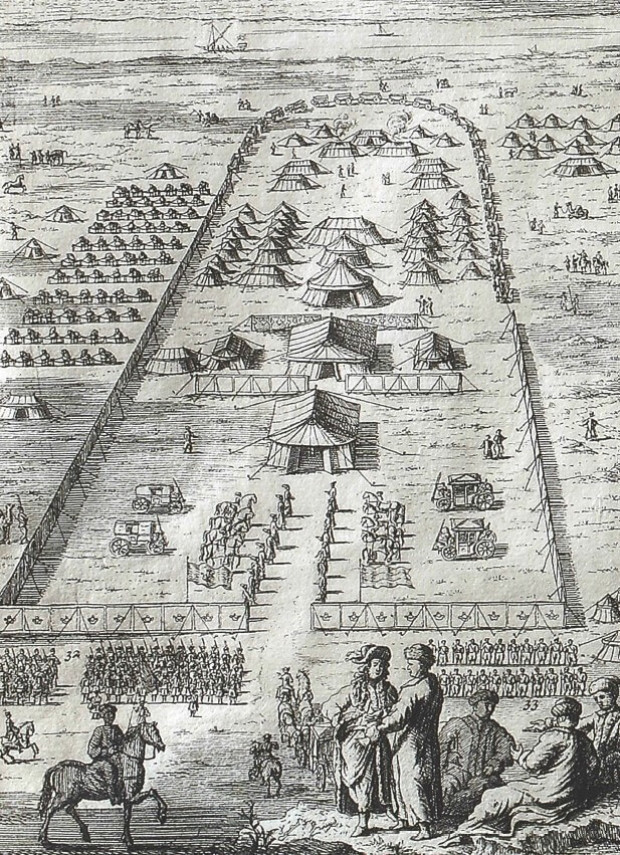
At the campsite designated by Count Marsigli, the Austrian and allied delegates and their entourages were set up on the Pétervárad side while the Turks were located on the Belgrade side. Between them lay the camp of the English and Dutch mediators. As a venue for the talks, a large wooden house divided into three wings and modeled after the Ryswick Palace in the Netherlands was erected in the mediators’ camp. Each negotiating party – Christians, Ottomans, and the mediators – had their own separate entrance, thus avoiding the possibility of discrimination or favoritism. Each party, likewise, had a separate room to which they could retire during the discussions – whether to deliberate on a particularly difficult issue or to eat and rest. The bilateral talks themselves took place in a large room located in the middle of the building.
Austria’s allies were unable to achieve similar results during their negotiations. Contrary to preliminary arrangements, the Venetians took their seats at the negotiating table after the Austrians. The tension between the Venetian republic’s continued great power aspirations and its diminished strength was clearly evident during the peace negotiations as Ruzzini put forward demands based on uti possidetis that the Turks found completely unacceptable. Both sides claimed the Peloponnese peninsula and the island of Santa Maura (Lefkada) while disagreeing over the surrender or destruction of the fortresses at Lepanto, Preveza, and the Dardanelles. Ruzzini drew on all his skill and charm – augmented with the persuasive power of gifts – in order to determine where the Turks might be amenable to compromise. The Turks, however, were unwilling to take a position regarding Dalmatia – the other area of contention – until matters concerning the Peloponnese and the Venetian mainland (terraferma) had been settled.
Such matters went far beyond Ruzzini’s purview, so he sent a report to the Venetian Senate, seeking the opinion of the republic’s leaders. The Turks were well aware of the reasons for Vienna’s haste in concluding a treaty, but they had their reasons as well, as they wished to extort what they could from the maritime republic that most threatened their interests. The Venetians, however, were adamant that the border line – especially in the case of Dalmatia – run in a straight unbroken line, a demand which would have left the Republic of Ragusa (present-day Dubrovnik) at a disadvantage as it would essentially be surrounded by the Venetians. Venice’s ambitions, however, found favor neither with the Turks nor with the Austrians, especially after the Ragusans had placed themselves under Habsburg protection. The Venetian position was rendered even more problematic on January 24, after the Russian ambassador signed a two-year ceasefire with the Turks. The Austrian delegation as well as the Polish ambassador, who had long been eager to return home, now granted the Venetians only two more days to come to terms with the Turks. On January 26, Ruzzini had no other choice but to concede to having the Austrian and Polish envoys negotiate with the Turks on Venice’s behalf. Thus, Poland and Austria signed the peace treaty between the Turks and Venetians instead, with the stipulation that Venetians could accept the outcome of the treaty without changes or could exercise the right to engage in another six months of negotiations with the Turks in Vienna.
Setting the boundaries
The previous peace treaties concluded between the Habsburgs and the Ottomans addressed only a temporary suspension of hostilities between the two empires, with the border region and grey zones providing an excellent opportunity and pretext for renewed conflicts. One of the most significant innovations of the Treaty of Karlowitz is that it set out in broad terms the future boundaries, or limits, of the two neighboring states. By agreeing to this, the Ottomans accepted the concept of territorial integrity, as stated in Article 6 of the treaty: “The limits prescribed by these articles, and those which shall hereafter be settled (if need be) by the Commissioners, shall be sacredly and religiously observed on both sides, in such a manner that they shall on no account or pretext be extended, transferred, or changed. Nor shall it be lawful for either of the contracting parties to claim or exercise any right or power over any territory of the other party beyond the settled bounds or lines; or to compel the subjects of the other party to pay any tribute whatsoever, past or future; or to subject them to any kind of exaction or harassment that can be imagined…”
The parties to the treaty agreed that, within a specified time, commissioners would be appointed to demarcate the permanent political border between the states using fixed boundary markers. The survey, originally expected to last two months, took three years to complete, with the Bologna-born Luigi Fedinando Marsigle performing this task for the Habsburg Empire. The first section of the border, passing through Croatia, was completed by July 1700, while the second stage, concerning the Temesvár district and Transylvania, was completed by February 1701. By first determining the border diplomatically and then demarcating it with physical markers, the Ottomans established a new framework for political relations. This shift brought a newfound sense of peace, tranquility, and security to the recaptured Hungarian territories and the border zone—essentially a military area—than had existed in the previous period.
According to the preliminary arrangements, the Poles were third in line at the negotiating table. Between their military failures in the field and their unstable domestic and foreign policy situation, the Poles were forced to negotiate from a rather weak position and, in the end, failed to achieve their more ambitious objectives: Although they regained the fortress of Kamieniec-Podolski and control over the now devastated region of Podolia, the Turks merely brushed aside their demands regarding the annexation of northern Moldavia. Furthermore, with respect to the Crimean Tatars, the Russian envoy noted that the Poles “settled for an empty promise” regarding both an end to Tatar raiding and the liberation of Polish captives.
The order of the peace negotiations was such that the Russian envoy found himself in the distinct disadvantage of being the last to sit down with the Turks. Voznitsyn seized on every opportunity to delay or complicate the negotiations in order to prevent a formal peace treaty in favor of a truce, as the Russians were not satisfied with their current territorial gains. Voznitsyn submitted a ten-point proposal, after which negotiations stalled regarding the proposed relations between the Ottoman Porte and the Crimean Tatars and the status of the fortress at Kerch, on the eastern tip of the Crimea. The mediators’ arguments – that if the others made peace with the Turks, the Russians would be facing the Turks alone – failed to sway the Russian negotiators. Nevertheless, on January 24, 1699, two days before the others, Voznitsyn signed a two-year armistice with the Turks amid a great show of pomp and ceremony. A formal treaty – the Peace of Constantinople – was not concluded until July 13, 1700, but despite significant compromises on both sides, neither party regarded it as anything more than a temporary truce.
The formal and ceremonial aspects of the peace talks indicated that the Muslim and Christian negotiators now engaged in diplomatic talks as equal parties, conducting negotiations in accordance with modern European concepts. With the conclusion of the Treaty of Karlowitz, the Ottoman Empire formally acknowledged that its era of conquest and expansion had come to an end. In the process, a new system of relations with the European great powers was established, one incorporating the rivalry between the House of Habsburg and Louis the Sun King’s France as an integral element.
In accordance with the precepts of Islam, the 25-year peace treaty with the Habsburgs and the 30-year treaty with the Russians were regarded as mere temporary cessations of hostilities. By contrast, the treaties signed with Poland and the Republic of Venice, which for the first time in Ottoman history had no time limit, were interpreted by the signatories as a lasting peace. Contrary to their established legal practice, the Ottomans also had to accept a precise written statement and physical demarcation of the borders between the two empires, particularly those of the Hungarian territories recaptured by the Habsburgs. By doing so, they recognized the inviolability of these borders and, consequently, the territorial integrity of another state.
With the 25-year peace treaty signed, the doors to the conference room were opened, and Paget read out the terms in Latin. Once both sides verified the translations, the respective peace treaties were signed, sealed, and exchanged – Austria and its allies presenting the Latin version to the Ottomans and the Ottomans providing the Turkish version to the Christians. The envoys exchanged greetings and embraced each other and then, having notified their troops, celebrated the arrival of peace amid cannon fire and cheers. The signing ceremony was followed by almost a week of feasting, visits, and farewells accompanied by gift-giving. Although Hungary was kept far away from the negotiating table, it gained the most from the subsequent peace – it had been liberated from a century and a half of Ottoman rule.
(translated by John Puckett and Andrea Thürmer)