Free to read


During his tenure as the minister of religion and public education, Count Kuno Klebelsberg (r. 1922–1931) not only launched the largest public education investment program in Hungary’s history—establishing elementary schools within the country and scientific and cultural institutions abroad—he also had a decisive role to play in the building of the universities in Debrecen and Szeged. Together with Szilveszter Somogyi—the mayor of Szeged—and Gyula Glattfelder—the bishop of Csanád—Klebelsberg helped spearhead the largest investment undertaken by the Hungarian government in the interwar period: the construction of a new home for the Royal Hungarian Franz Joseph University, which had to move from Kolozsvár (Cluj-Napoca) to Szeged after the Trianon Treaty. Between 1926 and 1930, an entirely new district was built in the city to accommodate the university’s teaching, research, and medical activities. Every part of the university’s grounds and buildings testifies to Klebelsberg’s imaginative spirit, organizational skills, and unwavering desire to create.
By 1918, the educational policies pursued by the Dualist Monarchy had brought about a diverse network of higher education institutions in Hungary; four universities now existed (Kolozsvár, Debrecen, Pozsony, and Budapest), as well as a technical university (Budapest) and a number of vocational colleges, law academies, and commercial schools serving the advanced educational needs of young people. However, this rich array of institutions suffered from a severe shortage of buildings to house them, a matter made worse from the end of 1918 by incursions from neighboring states and the loss of the main campuses of several universities and colleges (Kolozsvár, Pozsony, Selmecbánya, Kassa, etc.). Thus, Hungarian higher education policy had to contend with two key challenges: on the one hand, it had to ensure the relocation and continued operation of the exiled universities (Kolozsvár and Pozsony) and the displaced college in Selmecbánya; on the other hand, it had to see to the successful completion of the projects centered on the University of Debrecen, whose construction had only recently begun, only to be halted in the fall of 1918.
Financial requisites
Count Kuno Klebelsberg, who assumed the duties of minister of religion and public education on June 16, 1922, spent that summer inspecting the still partially constructed site intended to house the University of Debrecen medical faculty as well as the buildings selected to house the former University of Pozsony in Pécs. Shortly after, he paid a two-day visit to Szeged, inspecting the collection of buildings serving as the temporary home of the former University of Kolozsvár. His entourage included the architect Flóris Korb, who designed most of the country’s university buildings. While in Szeged, the need for further investments in education arose, but these were precluded at the time with the ongoing university construction in Debrecen and preparations for relocating the exiled University of Pozsony to Pécs.
At a meeting of the Szeged City Council on October 31, 1923, a resolution was adopted to support the efforts to permanently relocate the University of Kolozsvár in Szeged. They petitioned the governor, the prime minister, and the relevant ministers to commence construction on the newly minted University of Szeged. To defray expenses, the city offered the necessary grounds and a 25-year lease on 500 acres of pastureland as its contribution. Pursuant to the authorization granted by the city council resolution, in June 1924, Mayor Szilveszter Somogyi held personal discussions with Minister Klebelsberg about securing funding for the proposed university development in Szeged.
In the end, the mayor was forced to commit the city to an amount eight times greater than that specified in the previous year’s council resolution in order to make the university a reality. In practical terms, this was equivalent to a 50-year lease on 2,000 acres of municipal agricultural land (24 wagons—that is, 240 tons of wheat from the Tisza region). By the spring of 1926, however, it had become clear that this was insufficient and the city would have to make an even larger contribution if it did not want to wait half a century for building to commence. Under a new agreement between the state and the city, both parties were to provide cash equivalent to 3.6 million and 4 million gold crowns, respectively, at the start of construction. The city was forced to take out a loan.
Between 1926 and 1932, the state allocated increasingly larger sums of money to the project. During this period, 62.7 percent of university-related capital expenditures went to Szeged, which was fourteen times more than the state funding allocated to the University of Pécs and nearly twice as much as that allocated to the University of Debrecen. More to the point, the University of Szeged was the only Hungarian university to be the recipient of capital funding between 1926 and 1929. This was due, among other things, to the city of Szeged making an exceptionally high contribution to the success of the capital project both at the time of the 1921 allocation and during the construction period between 1926 and 1931.
Choosing a location
Szeged’s view that the university be located inside the city was in line with Klebersberg’s considerations, and in 1922, several possible locations were explored. A number of people suggested following Debrecen’s example of establishing the university on a suburban campus. The Gedó district, located in north Szeged, was considered; however, this area was significantly smaller than Debrecen’s Nagyerdő and would have been insufficient to accommodate the entire university. Moreover, Gedó was located somewhat closer to the city center, meaning it would have been more expensive. Others argued in favor of Újszeged, located on the east bank of the Tisza River. This proposal would have seen the university built on the far side of Elizabeth Park and along the streets leading thereto. This part of the city was rejected, however, due to its undeveloped infrastructure, low-lying terrain, and proximity to the Yugoslav and Romanian borders. The decision-makers vacillated between the area bound by Mars and Kálvária squares—east of the city center—and the Palánk district, located in the inner city between the west bank of the Tisza River and the Votive Church then under construction. The former location, however, was adversely affected by its proximity to the main prison in Szeged as well as various factories.
On March 23, 1926, Count Klebelsberg arrived in Szeged, accompanied by a large ministerial delegation, to finalize the location of the university’s main campus. The minister carefully examined each plot of land, determined from the plans which medical faculty would be located where, and also ascertained which plots already belonged to the city and which still needed to be purchased. The minister ultimately concluded the location near the Votive Church was the most appropriate for the city. The first official meeting of the university construction committee took place the next day, and the Palánk location was clearly favored. In her memoir, Klebelsberg’s widow—Countess Sarolta Botka—recounted these events in a personal tone:
“It was a bright spring day, and the cathedral’s south tower was already complete. My husband went up alone and spent an hour and a half at the top from where he could survey the entire area around the church. By the time he had come down, his imagination had already formulated the aesthetic details of the space to be created—the layout of the buildings, the course of the main traffic routes, and an overall plan to deal with the problems of urban development. It was a unified composition demonstrating exceptional beauty and grandeur. Thus, the scheme provided as the basis for the architectural competition already presented a realistically structured framework, into which Béla Rerrich would later weave the inspired artistry of his magnificent creation.”
Considering the above, it would appear that Klebelsberg played a considerably more active role in determining the location of the university campus and in conceptualizing Szeged’s Cathedral Square than would normally be expected from a minister of religion and public education. It is thanks to him that this unique agglomeration of university and college buildings, medical facilities, dormitories, and training schools are organically embedded in the heart of Szeged, forming a kind of Latin Quarter.
Cathedral Square plans
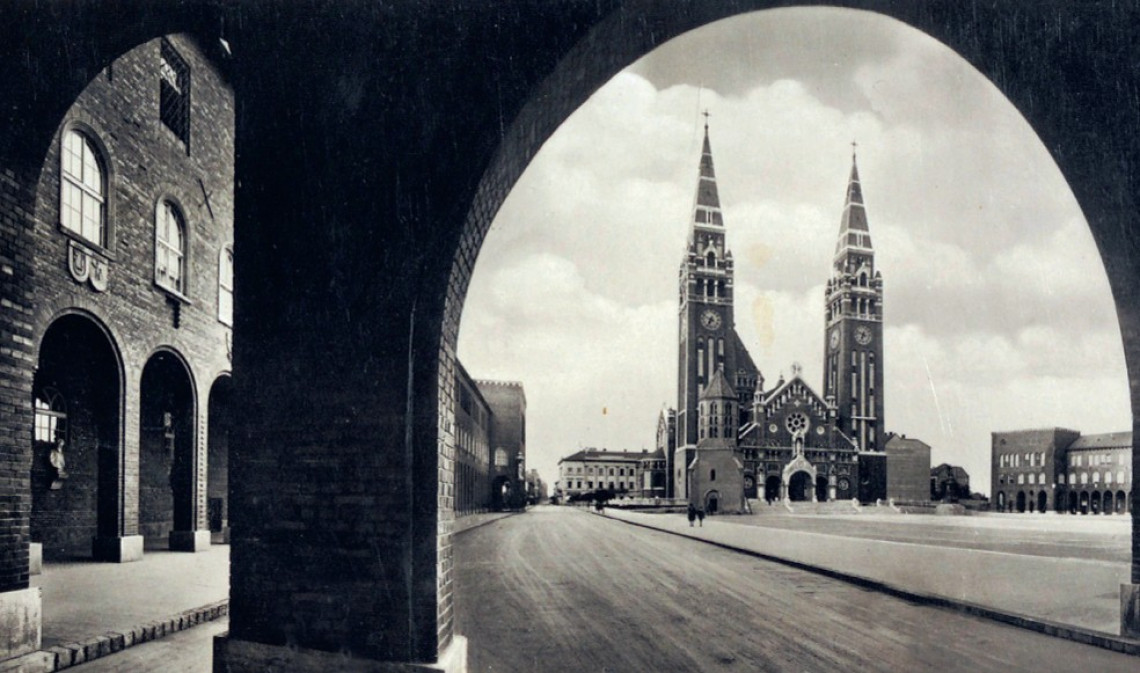
Led by Klebelsberg, the Ministry of Religion and Public Education announced a competition in late 1927 for the uniform design of Szeged’s Cathedral Square. Out of eighteen submissions, the committee chose the winning entry by the noted landscape architect Béla Rerrich. The following summer, Rerrich was also entrusted with overseeing the construction, while numerous modifications were made to his original plans. According to contemporary architectural opinion, the artistic character of the Cathedral Square complex lay in its meticulous attention to craftsmanship and detail. Both the overarching architecture and the finer embellishments reflected the broader mission of harmonizing the Catholic Church with the university sciences. There is nothing cliché or pedestrian; rather, it all reflects the devotion of the master artisan.
In emphasizing the buildings’ intended purposes throughout, the architect found countless opportunities for artistic nuances, with the resulting decorative elements not mere additions unrelated to the nature of the buildings but arising from specific functional needs.
The Szeged development was closely linked to plans to fill in the Danube lagoon at Lágymányos, in Budapest, and to reorganize the natural science institutes of the University of Budapest as a separate faculty at this location. Conceived as a “Hungarian Dahlem”—patterned after the famous academic district in Berlin—it would have established a unified university and research center in South Buda focused primarily on the natural sciences. In October 1927, however, the capital’s finance committee removed from its budget the 400,000 pengő previously earmarked for the Lágymányos land reclamation project, effectively derailing Klebelsberg’s ambitious and rationally conceived plan. With the cancellation of the planned research hub at Lágymányos, a significantly higher concentration of natural sciences institutes than originally envisioned was established on the southeastern quadrant of Szeged’s Cathedral Square.
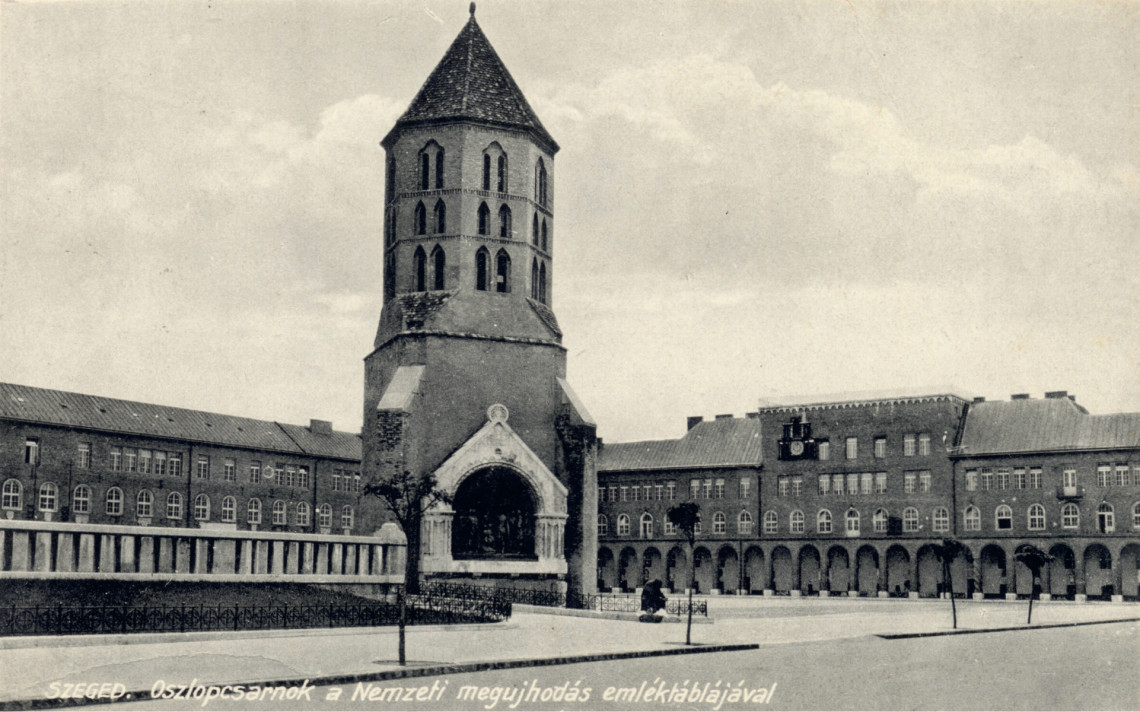
The medical and natural sciences institutes were constructed as an integrated complex facing the still-unfinished Votive Church, while the university clinics were strung along the bank of the Tisza River. The overarching architectural concept went beyond the university buildings as the western side of Cathedral Square—facing the Votive Church—became home to the central institutions of the Diocese of Csanád, which had been expelled from the former Temesvár (Timișoara) by the Romanian authorities: the bishop’s palace, the seminary, and Saint Imre College. Thus, the U-shaped agglomeration of buildings arrayed in the square facing the Votive Church served both the educational and research needs of the medical and natural sciences faculties of the state university and the needs of the central institutions of the Diocese of Csanád.
While the planning and construction of the diocesan buildings were underway, Klebelsberg began making arrangements to accommodate the state university’s Faculty of Theology in the diocesan complex. By this time, each of the country’s other three universities possessed an established faculty of theology: the University of Budapest had a Roman Catholic faculty; the University of Debrecen, a Reformed faculty; and the University of Pécs, a Lutheran Theological College (in Sopron). The Cathedral Square complex thus served as the physical embodiment of the minister’s concept of the unity of the sciences. Nevertheless, the minister’s efforts were ultimately in vain; although the buildings were completed in 1930, the finished complex housed a diocesan seminary for priestly formation instead of the intended university theological faculty.
The inauguration ceremony
The inaugural ceremonies for Szeged’s new public and higher education buildings took place between October 23 and 26, 1930, as part of a grand series of events. On the morning of October 23, the statues of Saint Imre and Saint Gellért were set into the façade of the episcopal buildings on Cathedral Square and consecrated in an open-air mass. The selection of the two saints was related to the forced relocation in 1923 of the episcopal seat and bishop’s residence of the Csanád diocese, founded in 1030, to Szeged; as the first bishop of Csanád, Saint Gellért was chosen alongside his pupil, Prince Imre. The statues symbolized the continuity of the diocese’s operations.
Klebelsberg arrived in Szeged by plane at noon on October 23, accompanied by his ministry staff. This gave him the opportunity to survey the rural schools between the Danube and Tisza rivers and the university buildings in downtown Szeged from a bird’s-eye view. His widow, Sarolta Botka, recounted this emotional event in her memoirs:
“[My husband] flew to Szeged for the square’s dedication in the fall of 1930. Those with him at the time recall the rapt joy and emotion with which he marvelled at the schools that had sprung up amid isolated farmsteads.”
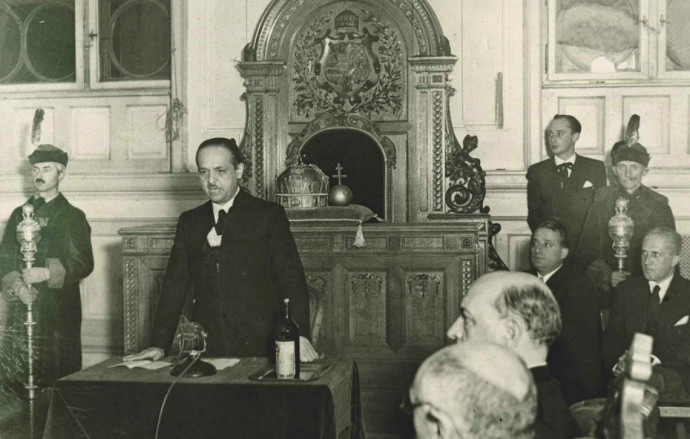
The following day, October 24, a ceremonial gathering held in the grand chamber of Szeged City Hall conferred honorary citizenship upon Count Klebelsberg in recognition of his contributions to the city’s cultural and educational development. Rector Ferenc Kováts recalled the circumstances of the university’s forced expulsion from Kolozsvár in 1919, and then the minister gave a lecture entitled “The University’s Relationship with its Host City and its Region.”
“So much has been done, but there is so much left to do. Nevertheless, the greater part has been accomplished. Those sections already constructed required tremendous sacrifice on the part of the state and the city. I would like to look those people in the eye who dared to mock us when the university was founded. Let them stand before the rector and the university council today and try to slander this work now. And yet the greatness of the university is largely thanks to its faculty as well. Here, teachers do not look down upon students from an Olympian height but rather know, love, and understand the spirit of youth. May God grant that the seed I have sown here may grow, multiply, and flourish in the fertile Hungarian soil.”
On the morning of October 25, the Votive Church and the György Zala-designed National Restoration Monument, embedded in the side of the Dömötör Tower, were consecrated; additionally, the five-thousandth classroom of the National Primary School Building Program was opened at the Rókusi school, and the National Pantheon located beneath the arcades was dedicated. Sarolta Botka also recalled this moment in her memoirs:
“With the bells of the cathedral and the entire city ringing in unison, the procession set out across the sunlit square before the governor, with separate ceremonial processions representing the church, the city, the university, and the artists and artisans. Klebelsberg led the latter procession, accompanied by the architects of the cathedral and the square, Ernő Foerk and Béla Rerrich, and the composer Ernő Dohnányi—who wrote the Szeged Mass. Then followed a long procession of creators: painters, sculptors, applied artists, master builders, organ builders, masons, craftsmen, and foremen down to the very last laborer. He led each and every one of them before the head of state as his own creative collaborators. This was perhaps the happiest day of Klebelsberg the builder’s life.”
The conceptual significance of the square was also clearly articulated in Count Klebelsberg’s dedication speech:
“Szeged’s Cathedral Square shall be a symbol not only of Hungarian planning and cooperation but also a triumph of the university ideal. […] All of us, the low and the high alike, were brought together in a close community of work by a shared desire to create something of lasting honor for our nation, something that would proclaim to our descendants that this generation of Trianon did not lose heart but looked cruel fate manfully in the eye. Let this square be a massive testament, built in brick, carved in stone, and cast in bronze: ‘No, no, never!’”
The national significance of the Szeged building project was even noted in the capital’s newspapers, and in their coverage of the week-long celebration, they highlighted that all this is a promise that the country, too, will rise again—“just as Szeged rose again after the great flood.”
***
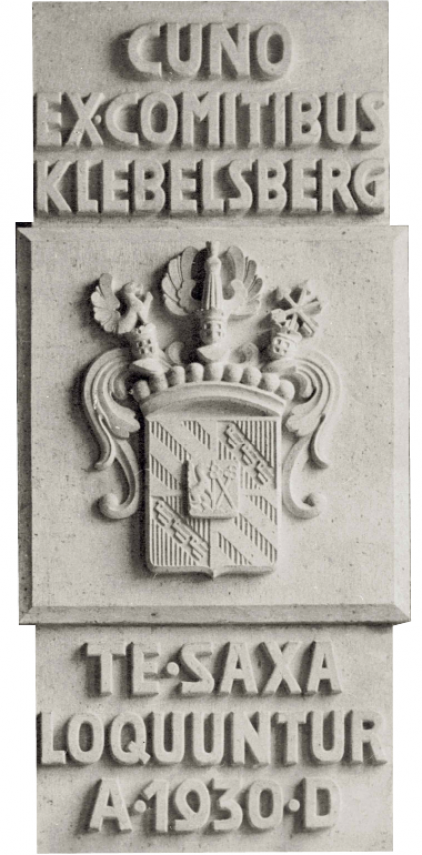
In a gesture of respect for Count Kuno Klebelsberg, a memorial plaque of white limestone was commissioned from donations by the faculty of the University of Szeged to honor the minister for his work in developing the university. Completed in the spring of 1931, the plaque was installed at the entrance to the National Pantheon, beneath the eastern arch of the Saint Gellért Gate that connects Gizella Square to Cathedral Square. The monument, designed by Béla Rerrich and Béla Ohmann, depicts the coat of arms of the Klebelsberg family with the words “Te saxa loquuntur” (“The stones speak of you”).
(translated by John Puckett and Andrea Thürmer)